Presidents of Azerbaijan and Uzbekistan make press statements - UPDATED
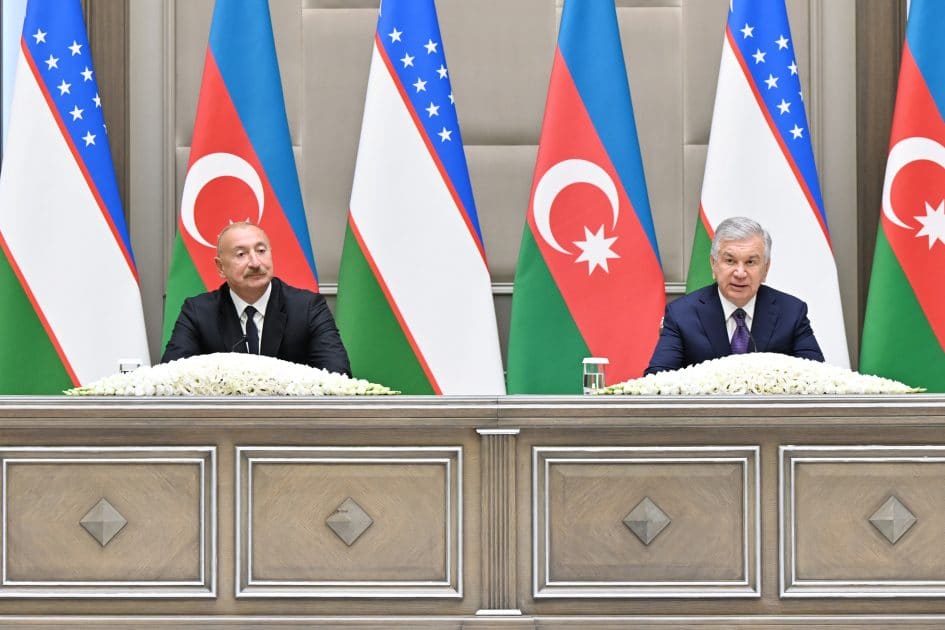
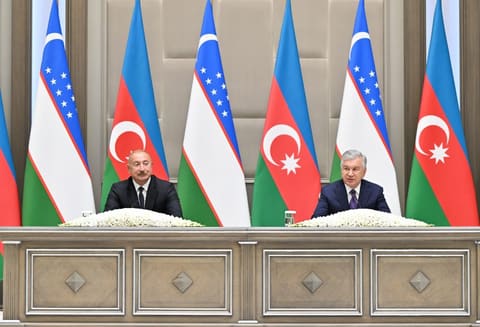
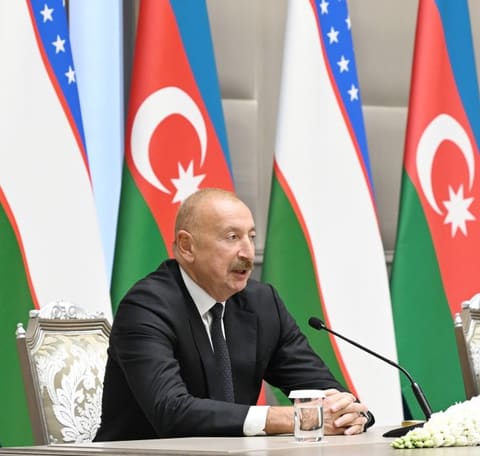
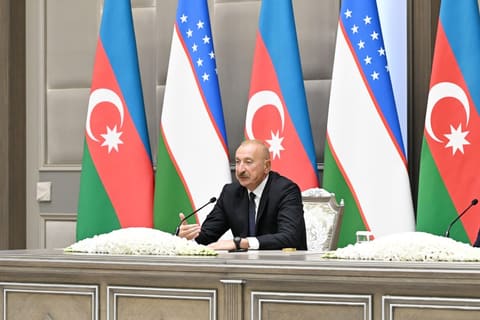
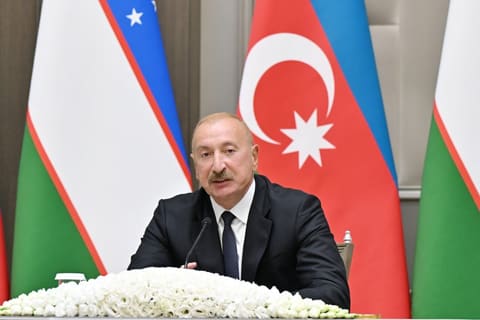
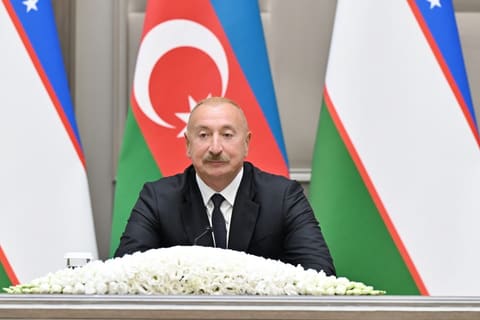
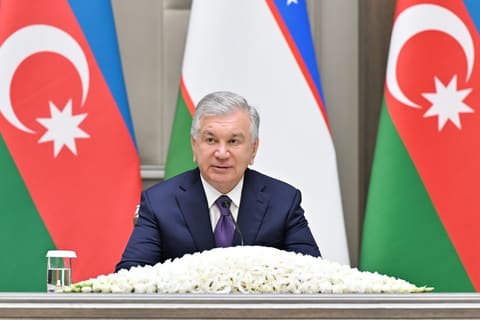
On August 23, President of the Republic of Azerbaijan Ilham Aliyev and President of the Republic of Uzbekistan Shavkat Mirziyoyev delivered statements to the press in Tashkent.
AZERTAC reports that the President of Uzbekistan spoke first.
President Shavkat Mirziyoyev’s
statement
- Dear Ilham Heydar oglu,
Distinguished members of the media,
In your presence, I am delighted to once again extend my heartfelt welcome to the President of the Republic of Azerbaijan, my dear brother, distinguished Ilham Heydar oglu Aliyev, and all members of the Azerbaijani delegation to the hospitable land of Uzbekistan.
The current state visit of the President of Azerbaijan to Uzbekistan is, without exaggeration, of historic significance. We have spoken about this repeatedly today, because all the documents signed and all the matters agreed upon represent historic milestones for our bilateral cooperation. Today, we signed the Treaty on Eternal Friendship. You can imagine the high level our regional, business, governmental, and interparliamentary relations have already reached. This is not merely a document, but a reflection of our shared aspiration to deepen mutual engagement, expand opportunities for cooperation, and build a common future.
Dear friends, we in Uzbekistan always genuinely rejoice in every success of brotherly Azerbaijan, its sustained economic growth, and its rising international stature. I would like to specifically highlight the purposeful nature of Ilham Heydar oglu's political course. Thanks to this policy, it was possible to restore the country's territorial integrity and achieve long-awaited peace and stability. The ancient land of Karabakh is being revived. Social infrastructure is being actively built, and jobs and enterprises are being created there. Everything is being done to enable people to return to a peaceful and prosperous life. Azerbaijan is our reliable ally, strategic partner, and brotherly state. Our relations are anchored in a shared civilizational code, common historical roots, centuries-old friendship, enduring spiritual values, and similar culture and traditions. It is this profound bond that makes our ties solid and resilient against external fluctuations.
Distinguished journalists, extensive preparations were carried out ahead of this summit. The sessions of the Intergovernmental Commission, the Business Council, and regional forums proved highly productive. We have just concluded the third meeting of the Supreme Interstate Council, the centerpiece of this state visit, where we adopted vital decisions, thoroughly reviewed the entire spectrum of our multifaceted relations, and heard reports from delegation members on key areas. Above all, this concerns trade, industrial cooperation, energy, transport, culture, and other fields. We agreed to strengthen political dialogue and maintain active contacts between parliaments and governments, industrial agencies, and regions. We paid special attention to economic matters and discussed opportunities to bring bilateral trade turnover to $1 billion. However, we agreed that this is not the limit and that it can be multiplied several times over.
We will accomplish this. Our teams have all the calculations, resources, and authority required. A relevant program outlining specific measures to reach this important milestone was adopted today. We also identified new directions for industrial cooperation, primarily in sectors where our economies complement one another. Ahead of this visit, a comprehensive portfolio of cooperative projects spanning energy, geology, chemicals, construction, finance, agriculture, and other fields had been formed.
The investment fund established several years ago plays a vital role in advancing these projects and has quickly proven to be an effective mechanism for supporting our joint business initiatives. We also agreed to make maximum use of the potential of our regions. Regions serve as the primary driving force behind the expansion of trade and economic partnerships. To this end, the khokims of Tashkent city, Bukhara, and Namangan regions visited Azerbaijan this month. Today they are here. Frankly speaking, they are updating me on the work accomplished. Ilham Heydar oglu, I am very pleased that they have delivered real results.
Another crucial area of cooperation is transport and transit. Together, we will advance the potential of the Trans-Caspian Corridor, enhance the efficiency of logistical infrastructure, and encourage freight traffic. To achieve this, we will step up efforts toward establishing a joint fleet in the Caspian Sea.
Close cultural and humanitarian ties serve as a reliable bridge of friendship between our peoples. Together with Ilham Heydar oglu, we will inaugurate the new building of the Nizami Ganjavi Pedagogical University.
You know, I had been planning this for a long time, as the university was built in 1935, but its facilities in Tashkent were scattered across various locations and did not meet modern standards. When laying the foundation stone, I hoped we would definitely open it together with Ilham Heydar oglu, and today that historic event is taking place. We will also launch the construction of the Azerbaijan Park in 'New Tashkent.' I am confident these sites will become shining symbols of our unbreakable brotherhood and the closeness of our peoples.
Our mutual humanitarian engagement is progressing along a very dynamic track. By the end of the year, we will host the Days of Azerbaijani Culture in Uzbekistan and the Second Forum of University Rectors in Azerbaijan. A notable milestone will be the production of a joint feature film dedicated to the literary heritage of Nizami Ganjavi and Alisher Navoi. Ilham Heydar oglu and I have reached an agreement on this.
We will support public and youth contacts by all means and create venues for communication, creativity, and the exchange of innovative ideas.
As you know, by FIFA's decision, Uzbekistan and Azerbaijan will co-host the youth football world championship next year—the world's second most prestigious tournament. Within the framework of this grand sporting event, our countries have proposed implementing a large-scale state program titled 'Two Countries – One Championship.'
In conclusion, I want to emphasize that cooperation between Uzbekistan and Azerbaijan has long moved beyond a strictly bilateral agenda. Azerbaijan's accession to the format of Consultative Meetings of the Heads of State of Central Asia marked a historic step toward shaping a unified space of trust, good neighborliness, and interconnectivity between Central Asia and the South Caucasus. We consistently coordinate our diplomatic efforts by reinforcing allied dialogue on key international platforms within the UN, the Non-Aligned Movement, the Organization of Turkic States, the Organization of Islamic Cooperation, the CIS, and other structures.
Dear friends, reality itself and the depth of our discussions demonstrate the broad scope and remarkable momentum gained by the Uzbekistan-Azerbaijan practical cooperation agenda.
Following today’s fruitful negotiations, we confirmed a substantial package of agreements across the most critical areas of our interaction. Distinguished Ilham Heydar oglu, I extend my heartfelt gratitude to you for your decisive stance and for supporting all our proposals. I am convinced that the outcomes of this historic visit will enrich our partnership with tangible substance, opening new horizons for joint initiatives and the sustainable development of our two brotherly nations.
Thank you for your attention.
x x x
The President of Azerbaijan then delivered his statement.
President Ilham Aliyev’s
statement
- Thank you, dear Shavkat Miromonovich.
Dear friends,
First of all, I would like to express my gratitude once again for the invitation, the warm hospitality, and the sincere attitude shown toward Azerbaijan and the Azerbaijani people.
As you know, we share the same warm and brotherly feelings toward Uzbekistan and its brotherly people. I believe the results of today's visit reaffirm this once more. First and foremost, I would like to note that this is not my first visit to Tashkent, and every time I come here, I witness rapid development. This can be seen in every area—both in major projects and in the finer details. Today, Tashkent and all of Uzbekistan are experiencing a period of resurgence. This is the result of the efforts of my dear brother Shavkat Miromonovich, aimed at strengthening Uzbekistan's potential, consolidating its standing in the international arena, and addressing the most critical socio-economic tasks.
When Shavkat Miromonovich assumed leadership of Uzbekistan, the situation was completely different. The citizens of Uzbekistan know this well, and we know it as well. Therefore, putting the country on a development trajectory required immense effort on his part: essentially building the economic foundation for national development from scratch, diversifying the economy, advancing industry, diversifying agriculture, and attracting investments into sectors that hold and retain tremendous potential. Today, we see an entirely different Uzbekistan. This is an Uzbekistan deeply respected by the global community, where matters related to industrial growth, agriculture, energy, and transport infrastructure are addressed swiftly and efficiently. Everything Shavkat Miromonovich mentioned regarding our bilateral relations reflects, first and foremost, the work he and his team have accomplished for Uzbekistan.
I have already noted this today: without this foundation and this potential, implementing any joint projects would have been impossible. In fact, before Shavkat Miromonovich took office, there were no joint projects between our countries. Today, we speak of the one-billion-dollar trade turnover target not as a distant dream, but as an outcome we will likely achieve within a few years. Everything discussed today—mutual investment projects in sectors our economies demand and require—would not have been possible had both nations not been developing along parallel lines. And this parallel trajectory has now become an essential factor in broader geopolitics. Because, as Shavkat Miromonovich noted, the geography of cooperation has expanded following Azerbaijan's integration into the format of cooperation with Central Asian nations—a process in which he played a pivotal role.
Today, Central Asia and Azerbaijan form a unified geopolitical and geo-economic region endowed with great potential and even greater development prospects. The overall positive momentum of this large, virtually reborn, and already well-integrated region also hinges on close interaction between Uzbekistan and Azerbaijan.
Each of the projects we discussed today carries its own value, and as Shavkat Miromonovich remarked, together they define the unique character of our relations. We have virtually covered all areas, spanning energy, transport, investment projects, tourism, mining cooperation, the automotive industry, agriculture, and the processing sectors. Even enumerating the projects whose foundations were laid or launched at the conclusion of today's official bilateral events is enough to demonstrate how multifaceted our cooperation is. Indeed, I have not even mentioned our cooperation in banking—with a leading Azerbaijani bank entering the Uzbek market—and SOCAR's entry into Uzbekistan's retail market. In oil and gas exploration projects, we are practically in the final phase and look forward to commencing the drilling of production wells next year. I hope subsequent exploration and drilling activities will yield successful results.
In other words, today we are already discussing prospects. The reality is that bilateral relations today rest on very solid foundations—both spiritual and material. Such a synthesis is rare in world politics, yet it exists here. The commitment of both governments to foster development, create better living conditions, and join forces is the single most important factor ensuring our success.
Of course, I would like to emphasize once again President Shavkat Miromonovich Mirziyoyev's exceptional role in attracting investment to Karabakh. The first support—the construction of the 960-student Mirza Ulugbek school in Fuzuli and investments in the textile factory in Khankendi—came from Uzbekistan. The first major industrial enterprise is also linked to Uzbekistan. There are plans for additional interaction both in the Karabakh region and across many other regions. It is also noteworthy that during today's groundbreaking and inauguration ceremonies for numerous initiatives—around ten or perhaps even more—regional projects were prominently featured.
Projects are being carried out not only in Baku and Tashkent—though primary attention is naturally focused on these capitals—but in other regions as well. The interregional cooperation forum held yesterday generated great practical interest. In other words, to use a popular phrase, we are joining efforts to generate synergy. We possess a very clear action plan to move forward, and every single project is imbued with concrete substance. If we add the investment fund, a third of which is already committed to projects, along with investment projects in Azerbaijan's tourism infrastructure and automotive industry, this translates into billions in investments.
Investments are typically directed toward friendly nations—in our case, brotherly countries—and places that offer a favorable investment climate. To return to where I began: Shavkat Miromonovich's great achievement lies in the fact that through his reforms, resolve, and wisdom, he has cultivated an investment climate that allows international financial institutions and global actors alike to see Uzbekistan as a nation at a successful stage of its development.
As your friends and brothers, we are genuinely pleased by this, and I am confident that all the plans you outlined will materialize. We will work together to bring our nations and peoples even closer. In closing, Shavkat Miromonovich, I would like to invite you to pay a state visit to Azerbaijan at a time convenient for you. Thank you for your attention.
Describe your idea —
get your website in minutes.
Fotogalereya