Milli Majlis Condemns European Parliament Resolution on Azerbaijan as Biased Political Action
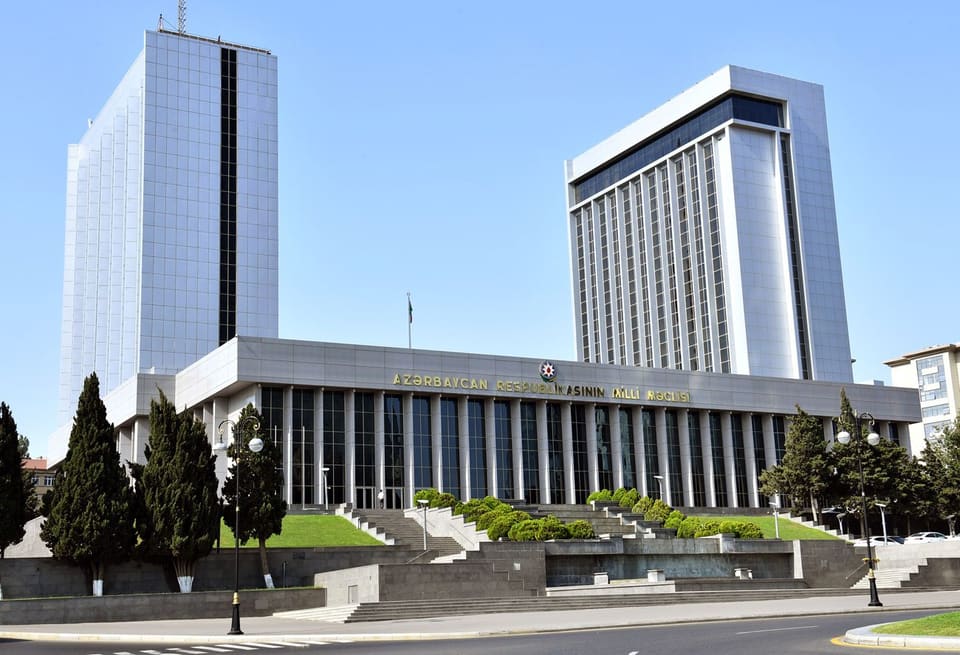
The Milli Majlis (Parliament) of Azerbaijan has responded to the European Parliament's resolution dated October 8, 2026.
Operativ Media reports that the Milli Majlis considers the European Parliament's resolution of October 8, 2026, regarding human rights and freedoms in Azerbaijan, which lacks objectivity, to be a biased political stunt against Azerbaijan, and strongly rejects its groundless accusations based on false and fabricated information.
In this regard, it should be specifically noted that the European Parliament's targeted political line against Azerbaijan has become increasingly confrontational since the Second Karabakh War. The numerous resolutions adopted by this body in recent years, its attempts to exert political pressure on our country, and its calls for sanctions should be viewed as the European Parliament's refusal to recognize the new geopolitical realities that emerged in the South Caucasus after Azerbaijan's historic victory.
Furthermore, it is surprising that the European Parliament continues its attempts to act as a supranational judge with the authority to define the jurisdiction of a sovereign country's state bodies, instruct its law enforcement and judicial institutions, and dictate the political terms of bilateral relations. Such behavior casts serious doubt on the objectivity of the European Parliament's approach and demonstrates its unwillingness to build relations with Azerbaijan based on the principles of equality, mutual respect, and non-interference in internal affairs.
All of this demonstrates that Azerbaijanophobic, Turkophobic, and Islamophobic sentiments prevail within the organization. The fact that several MEPs represent the interests of lobby groups rather than European voters points to their racist and chauvinistic stance. The authors of the resolution are even willing to jeopardize the European Union's South Caucasus policy to achieve their dirty political goals.
The situation within the European Parliament itself also raises serious questions. High-profile corruption investigations in recent years, including the bribery of MEPs and illegal influence over political decision-making, have damaged the organization's political reputation and undermined trust in established parliamentary procedures.
In this regard, a legitimate question arises: how credible can the political and moral accusations and lectures of an institution be when it has yet to address serious challenges regarding transparency, integrity, and independence in its own decision-making? Before making demands on other states, the European Parliament must demonstrate consistency in applying its own standards and establish reliable safeguards against corruption and illegal lobbying.
The European Parliament's discriminatory approach to human rights issues also raises serious questions. While resolutions are passed against Azerbaijan with explicit demands and calls for sanctions, European countries themselves continue to face numerous issues, including the excessive use of force by law enforcement, restrictions on the freedom of peaceful assembly, and a lack of accountability for violations.
The scale of these problems is confirmed by reports from international human rights organizations. In particular, cases of excessive police force during demonstrations in several European countries have been well-documented.
The Milli Majlis of the Republic of Azerbaijan believes that the European Parliament should pay greater attention to the protection of fundamental rights and freedoms in EU member states, including police violence, respect for the freedom of peaceful assembly, and accountability for the unlawful actions of officials. The universality of human rights standards, above all, requires their consistent and impartial application, without political selectivity or double standards.
Another concerning point is that this resolution was adopted at a time when the peace agenda between Azerbaijan and Armenia is moving forward, and when political responsibility and support for constructive dialogue are particularly crucial. It is clear that such unilateral initiatives and biased opinions hinder the building of mutual trust and create additional obstacles to the normalization of interstate relations.
While Azerbaijan and Armenia are making efforts to resolve their long-standing conflict, it is concerning that disruptive elements representing various political forces in the European Parliament are trying to reignite political and military tensions. Real support for regional stability and sustainable peace requires respecting the sovereignty and territorial integrity of nations, supporting direct dialogue, and refraining from actions that could fuel mutual distrust.
The contradiction between the European Parliament's call to restore cooperation with the Milli Majlis and its practice of adopting documents that cause sharp interparliamentary disputes should also be noted. Restoring trust requires a real change in approach, abandoning confrontational rhetoric, and recognizing the equal nature of interparliamentary relations, rather than merely making declarative calls.
Regarding the groundless claims in the resolution, Azerbaijan remains fully committed to protecting human rights and fundamental freedoms, ensuring the rule of law, and consistently implementing the principles of a state governed by law. The establishment and free functioning of democratic institutions, the creation of key components of civil society, and other factors demonstrate the Azerbaijani state's determination and will to advance along the path of democratic development.
It is also regrettable that while the European Parliament levels groundless accusations against Azerbaijan regarding human rights and freedoms, it has always chosen to remain silent on the rights of more than one million Azerbaijani refugees and internally displaced persons who were subjected to ethnic cleansing and acts of genocide, expelled from their homelands, and deprived of all rights and freedoms during the Armenian occupation of Azerbaijani territories.
Furthermore, the logic behind labeling individuals convicted of specific criminal offenses by court decisions as "political prisoners," or demanding the unconditional release of individuals facing charges under relevant articles of the criminal code based on reasonable suspicion of committing such acts, remains unclear. No individual or organization has the right to claim that a person's social status grants them immunity from prosecution.
The European Parliament must consider not only the political consequences of its decisions but also its responsibility to the millions of European citizens who have placed their trust in it. Citizens of European nations are right to expect objectivity, integrity, and commitment to democratic values from their elected representatives, rather than initiatives driven by biased political considerations.
The Milli Majlis of the Republic of Azerbaijan calls on the European Parliament to abandon its confrontational rhetoric toward our country and to stop interfering in our state's internal affairs. At the same time, the Azerbaijani parliament declares that no force can turn Azerbaijan away from its path of democratic development.