State Committee Calls on Iran and Armenia to Respect Historical Facts
Naming the ceremonial hall of the Blue Mosque in Yerevan—one of the examples of the ancient historical and cultural heritage of the Azerbaijani people—after Armenian poet Yeghishe Charents is another attempt aimed at distorting historical and cultural identity. It constitutes disrespect for universal values shared globally and enshrined in international conventions, as well as a provocation against efforts to foster an atmosphere of peace and mutual trust.
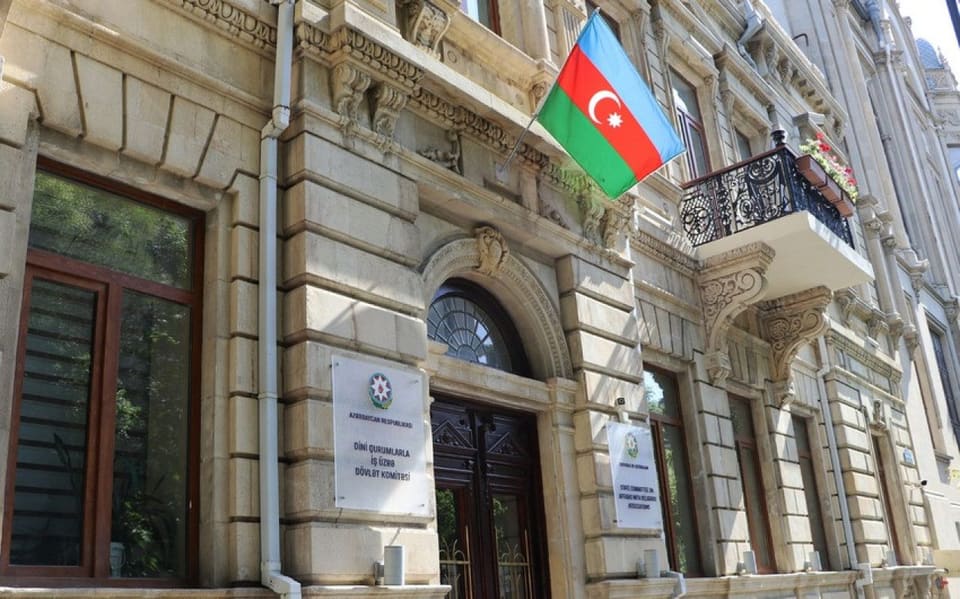
Operativ Media reports that this was stated in a statement by the State Committee on Work with Religious Associations.
The initiative to place a bust in the ceremonial hall of the Blue Mosque raises serious questions regarding the objective and unbiased stance of the Armenian side, particularly its political leadership, toward the original purpose and ownership of the historical monument. These attempts serve to background the Blue Mosque's historical-cultural identity and present it as a monument belonging to another culture. The preservation of historical monuments requires not only ensuring their physical existence, but also respecting their ownership, original purpose, and cultural identity.
The Blue Mosque is an important example of Azerbaijani architectural and religious heritage, built in the 18th century during the era of the Yerevan Khanate under the rule of Huseyn Ali Khan. Known historically as the Blue Mosque, Goy Jami, and Huseyn Ali Khan Mosque, this monument occupied a vital place in the religious and social life of Yerevan's Muslim population and played a significant role in shaping the city's cultural image. Its historical identity is directly linked to the mosque's architectural features, the period of its construction, and its place in the statehood history of the Yerevan Khanate.
During Soviet rule, religious activities were suspended here, and the building was used for various secular purposes, including as a museum. Under a 1995 agreement between Iran and Armenia, the funding of "reconstruction" works was assigned to the Iranian side. However, this process cannot serve as a basis for altering the mosque's historical ownership or presenting its original architectural features under the name of another culture. Restoring any cultural heritage item using a country's funds does not constitute a basis for claiming ownership by that country. The historical identity of the Blue Mosque should be evaluated based on the period of its construction, the Yerevan Khanate, and the city's connection to Azerbaijani cultural heritage. Attempts to present the monument as a "Persian mosque," as well as altering its name and historical context, serve political objectives rather than a scientific-historical approach.
We consider it necessary to emphasize that the protection of cultural heritage is a key principle of international law. UNESCO's 1954 Hague Convention for the Protection of Cultural Property in the Event of Armed Conflict provides for the safeguarding of cultural property during armed conflicts and the prevention of hostile acts, looting, and misappropriation against them. Furthermore, UNESCO's 1972 Convention Concerning the Protection of the World Cultural and Natural Heritage establishes the responsibility of states to identify, protect, conserve, and transmit to future generations the cultural heritage situated on their territory.
We note with regret that Armenia is once again employing today the negative practice it applied to mosques in Karabakh and Eastern Zangezur during the occupation. The Azerbaijani people have not forgotten the involvement of a company operating in the Islamic Republic of Iran under the guise of repair work at the Yukhari Govhar Agha Mosque in Shusha in 2019, nor the presentation of it and the Agdam Juma Mosque as "Persian mosques." We also remember with deep disappointment and regret the destruction and desecration of ancient mosques and places of worship in other formerly occupied territories, as well as acts of vandalism targeting the religious feelings of our people. Currently, the Azerbaijani state is restoring all religious and cultural monuments in the liberated territories, taking consistent measures toward their historical restoration. However, repairing physical destruction does not erase the moral scars that acts of vandalism committed during the occupation left on our people's historical memory.
We believe that uniform and objective criteria must be applied to the protection of cultural heritage, and that their ownership, original architectural features, and religious purpose must be respected during their restoration and use. In this regard, attempts aimed at distorting the historical identity of the Blue Mosque in Yerevan once again highlight the importance of upholding the same principles everywhere regarding cultural heritage.
We express our protest against attempts to distort the historical identity of the Blue Mosque and appropriate the cultural and religious heritage of the Azerbaijani people, and we call on Iran and Armenia to respect historical facts and refrain from using religious and cultural monuments for political and ideological purposes.