Cholpon-Ata Declaration Marks New Chapter in Azerbaijan-Central Asia Ties
Dynamic shifts in 21st-century global and regional relations have heightened the importance of multilateral cooperation among states. Deepening political dialogue, expanding economic integration, and strengthening security coordination among nations with shared historical, cultural, and civilizational values serve as key pillars of regional stability and sustainable development. In this context, the recent convergence between Azerbaijan and Central Asian nations not only advances bilateral ties but also shapes new platforms for cooperation across Eurasia.
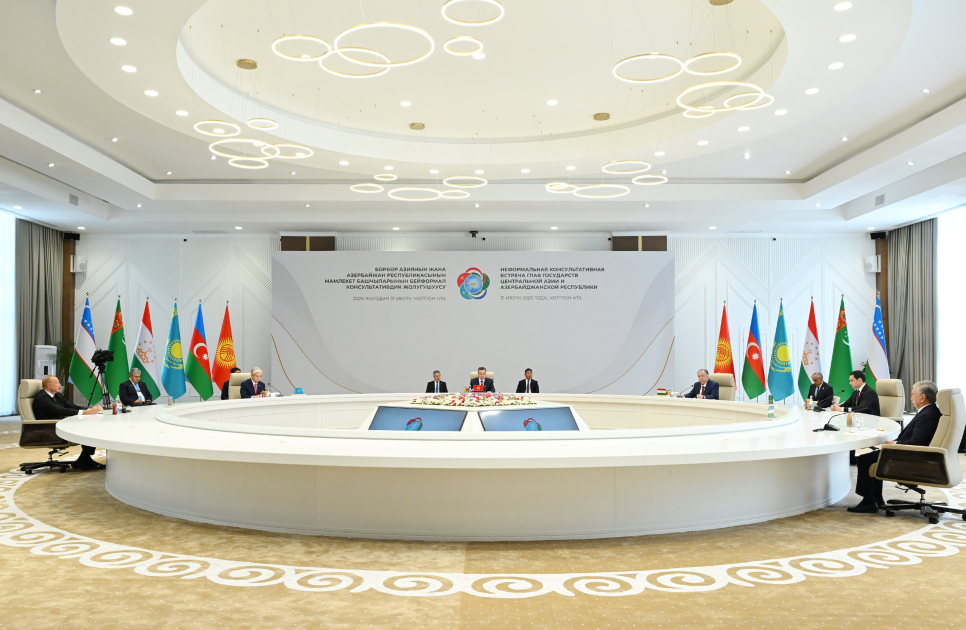
Against the backdrop of these political and geostrategic dynamics, significant steps are being taken to reinforce the institutional framework of cooperation between Azerbaijan and Central Asian states. The informal Consultative Meeting of the Heads of State of Azerbaijan and Central Asian countries, held on July 31 in Cholpon-Ata, Kyrgyzstan, was of particular importance. The Cholpon-Ata Declaration, signed at the conclusion of the summit, stands as a key political document reflecting the joint political will of the participating nations, establishing priority areas for cooperation, and laying down the core principles of future engagement.
AZERTAC examines the main provisions of the Cholpon-Ata Declaration and its significance for Azerbaijan-Central Asia cooperation.
Historical and cultural heritage and principles of international law
The core provisions of the Cholpon-Ata Declaration highlight the current level of relations and future development trajectories between Azerbaijan and Central Asian states. The declaration's strong emphasis on centuries-old historical, cultural, and civilizational ties demonstrates that this partnership rests not merely on current political and economic interests, but on shared historical roots, cultural affinity, and common spiritual values. In particular, the shared language, culture, and traditions of the Turkic peoples provide a solid foundation for deepening these ties.
Reaffirming commitment to fundamental principles of international law—such as sovereign equality, respect for state independence, territorial integrity, the inviolability of borders, and non-interference in internal affairs—carries profound political weight. These principles constitute the bedrock of modern international relations and serve to preserve mutual trust across the region.
The document notes that regional cooperation serves the fundamental interests of their peoples, underscoring that economic growth, security, and social well-being can best be achieved through joint effort. Under current geopolitical conditions, regional cooperation yields economic benefits while safeguarding political stability, ensuring coordinated responses to emerging challenges, and bolstering mutual trust. The declaration's high appraisal of the established political trust and good-neighborly relations reflects this vision.
The explicit appreciation of Azerbaijan's full participation in the Consultative Meeting of Central Asian Heads of State underlines the country's recognition as an indispensable regional partner. This status demonstrates that Azerbaijan's cooperation with Central Asian nations has entered a new phase, highlighting Baku's vital role in regional decision-making and international backing for its consistent policy of Turkic integration.
The declaration also affirms a commitment to strengthening future relations grounded in friendship, good-neighborliness, mutual respect, and trust. This climate of mutual trust creates essential groundwork for sustained political dialogue, successful economic projects, and peaceful resolution of regional issues.
Trade, investment, and transport-logistics cooperation
The leaders' declared readiness to expand regular political dialogue and practical cooperation signals an intent to build institutional depth into their relations. Boosting trade turnover, widening industrial cooperation, encouraging mutual investments, and enhancing transport-logistics collaboration will allow the region to unlock its economic potential more effectively. Transport and logistics represent a core pillar of the declaration. Specific focus on developing the Trans-Caspian International Transport Route (Middle Corridor) reinforces Azerbaijan's standing as a vital transit bridge between Europe and Asia. This route facilitates faster cargo transit, expands international trade, and integrates regional states into global transport networks, while coordinating alternative transport corridors will further enhance logistics capacity.
Prioritizing energy cooperation, particularly green energy, aligns with shared interests in the global energy transition. Azerbaijan's renewable energy projects, combined with the rich energy potential of Central Asian states, offer favorable prospects for large-scale regional cooperation. Furthermore, bolstering energy security and implementing mutually beneficial projects will enhance regional economic resilience.
The declaration also underscores the importance of advancing cooperation in digitalization, innovation, science, technology, artificial intelligence, digital infrastructure, and space technologies. These domains are key determinants of national competitiveness today. Exchanging scientific knowledge, implementing innovative projects, and applying advanced technologies will contribute to economic diversification, human capital development, and sustainable growth across the region.
Strengthening regional security
Strengthening security cooperation is essential for ensuring long-term, sustainable regional partnership. To this end, the Cholpon-Ata Declaration gives prominent focus to joint efforts against security threats. Reaffirming the urgency of countering terrorism, extremism, transnational organized crime, illicit drug trafficking, and other security risks confirms that security remains a top priority.
Because these threats affect regional security as a whole rather than individual states alone, addressing them requires coordinated action and mutual cooperation. Expanding information sharing, law enforcement collaboration, and joint initiatives within international organizations are critical in this regard.
Humanitarian cooperation and tourism ties in focus
Provisions expanding humanitarian cooperation play a key role in deepening mutual understanding and friendship between peoples. Developing ties in culture, education, science, youth policy, and tourism helps deepen interstate relations at the societal level. Expanding cooperation among universities, research institutes, and think tanks will support joint scientific projects, professional training, and shared academic platforms.
The document's emphasis on preserving cultural and civilizational diversity, historical traditions, and spiritual heritage indicates that integration will progress while safeguarding national identities and cultural diversity. This approach fosters mutual respect and tolerance among the peoples of the region.
Expanding tourism cooperation and supporting initiatives to enhance the region's appeal as a travel destination will complement economic ties by fostering direct people-to-people connections.
In conclusion, the Cholpon-Ata Declaration marks a new chapter in relations between Azerbaijan and Central Asian states while establishing strategic directions for future cooperation. The agreement's provisions deepen political dialogue, broaden economic integration, strengthen security, and develop humanitarian ties, laying a firm foundation for long-term peace, stability, and sustainable development across the region.