Valdas Dambrauskas: "We learned a lot from Qarabag"
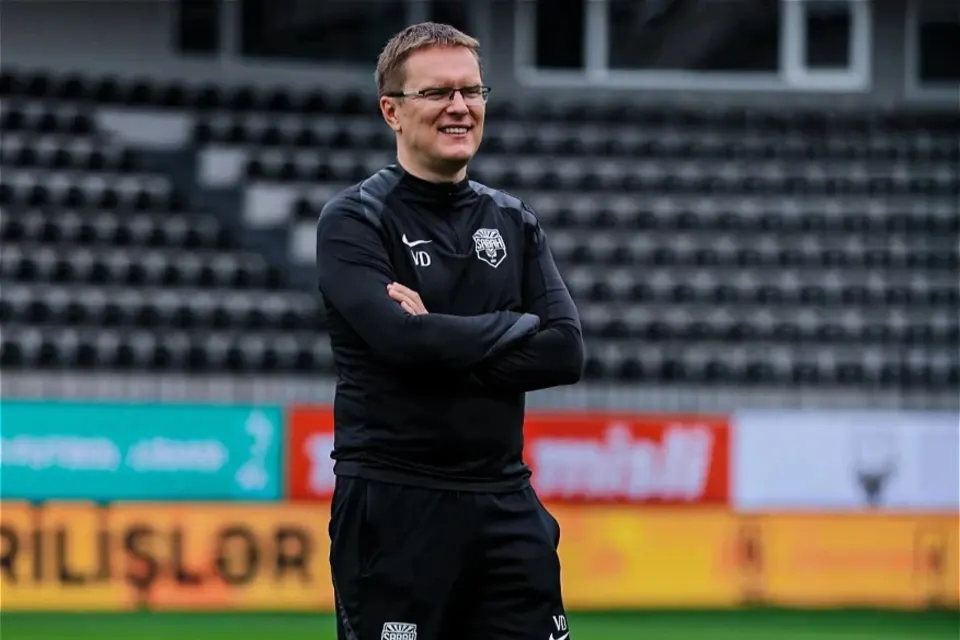
"I went on the 'Who Wants to Be a Millionaire?' show to compete and have fun. At 12 years old, when I realized I wouldn't become a professional player, I decided to become a football coach. Later, an opportunity arose to move to England. I went there for a better life and to develop my football coaching career."
Operativ Media reports that Sabah head coach Valdas Dambrauskas said this in an interview with Flashscore.
The Lithuanian specialist said he is happy to be working in football and to have made the sport his profession: "If not for this, I cannot imagine what would have happened. But I am sure I would have found a way to make my dream come true. From my first day in England, I dreamed of becoming a football coach. It happened in stages. First, I learned the language. Then I enrolled in Level 1, followed by Level 2 coaching courses. After that, I gained experience by conducting my first training session in youth football. I got a job in the academy of professional or semi-professional clubs. Then I earned a degree in sports science and coaching at university. I attended all kinds of courses and conferences to develop myself. Then I started dreaming and planning how to work in professional football. I understood that this was not possible in England, but I knew I would have such a chance in my homeland."
Dambrauskas, who belongs to the category of coaches who have never played football, emphasized that this is not an advantage: "I still believe that former football players are a step ahead in this sense. Because they command more respect among players, have more contact with them, and feel the atmosphere in the dressing room. However, football coaching has changed and evolved a lot over the years. Nowadays, a head coach is much more than just a leader or a tactical specialist. They must understand many things like physical preparation, human physiology, psychology, management, and financial matters. They must be a good organizer, a good communicator, analytical, and sometimes even an actor, not to mention having tactical knowledge. In addition, the most important aspect is emotional intelligence. I think players who start coaching immediately after ending their careers do not realize some of these responsibilities. Coaches who have never played football compensate for these shortcomings with daily training and self-improvement. I work every day to get better and keep working. What I fear most is to stop learning and developing."
Saying that his main playing philosophy is to dominate on the pitch, the head coach added: "I love to constantly attack and score goals. If I could describe my style of play in one word, it would be dominance. I am not afraid of taking risks. For me, the best result would be a 4-3 scoreline with four different players scoring and four different players providing assists. Can you imagine the dressing room after such a game? That is why I love teams and coaches who follow the same trend. Although this often changes. For example, I used to like Arsene Wenger's Arsenal, Marcelo Bielsa, Ralf Rangnick, and others. Currently, I also learn a lot from other sports, especially basketball, American football, rugby, ice hockey, and others. I think sometimes I get broader ideas from other sports than from football itself."
According to the specialist, working in different countries and getting to know different traditions is the greatest gift of his coaching career: "This has enriched me both as a person and as a football coach. In coaching, I always try to see the person, not just the player. You can only coach a football player by understanding the person. In the past, coaches kept their distance from players. My philosophy is to be as close to them as possible. Players from different countries play for Sabah. The experience I gained in different countries allows me to understand my players better and find ways to improve their performance."
He also spoke about the success achieved with Sabah and highlighted the Qarabag factor: "It was indeed an incredible season. There is a magnificent team in the local championship - Qarabag. Last season, they made a real breakthrough in the Champions League. They have won the Azerbaijani championship 12 times in the last 13 years and have played in the group stages of European competitions for 12 consecutive years. We learned a lot from Qarabag. They helped us become a better team. Every game between us was a top-level struggle tactically, psychologically, and technically. What Qarabag has done for Azerbaijani football is commendable. Even before coming to Azerbaijan, I watched their games with great interest, trying to understand how they achieved success. Every game against Qarabag was like a lesson equivalent to earning a university degree. I learned a lot from those matches and look forward to facing them again this season. Competition in Azerbaijani football will benefit everyone. Ambitious teams like Zira, Turan Tovuz, and Neftchi play here. I believe the Azerbaijan Premier League has a bright future."
Finally, Dambrauskas shared his thoughts on the Champions League: "Winning the championship, the national cup, and reaching the main stage of the Champions League in one season is incredible. This is the result of the hard work of everyone at the club, from the cleaning staff to the president. This is precisely the strength of Sabah: everyone at the club does their job and works in the same direction.
The Champions League is first and foremost a chance to test ourselves and compete with the best. This is not only exciting but also a great responsibility and opportunity. Playing in the Champions League is very important for the club's development. We can only develop as a team. We want to make the most of this opportunity."
It should be noted that in the main stage of the Champions League, Sabah will face Spain's Barcelona, Germany's Borussia Dortmund, Spain's Villarreal, Italy's Napoli, the Czech Republic's Slavia Prague, Norway's Viking (away), and England's Arsenal and Manchester United.