Turkish-American researcher publishes open letter criticizing Taleb's stance on Vardanyan
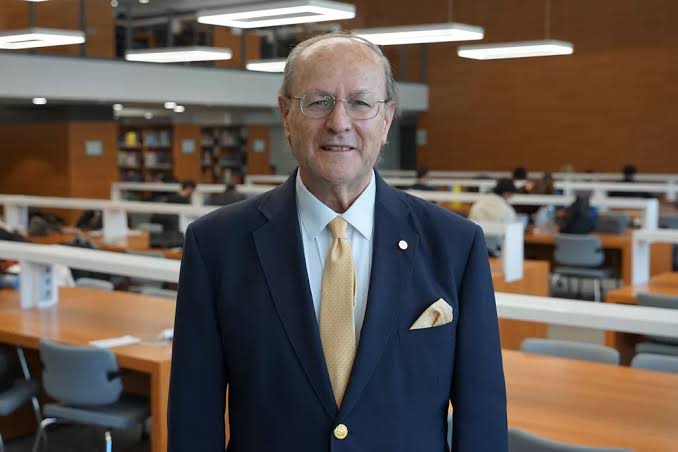
Turkish-American engineer, researcher and writer Ergun Kirlikovali has addressed an open letter to Lebanese-American author Nassim Nicholas Taleb, calling on him to reconsider his position regarding Ruben Vardanyan, Operativ Media reports.
Kirlikovali commented on Taleb's recent public statement on the social media platform X, in which he said he would refuse to lecture in Baku as long as Ruben Vardanyan remains imprisoned.
The letter reads:
"Dear Nassim Nicholas Taleb,
I am writing to you regarding your recent public declaration on X stating that you refuse to lecture in Baku while Ruben Vardanyan remains imprisoned.
As an author who has spent a career warning the world about hidden financial risks, narrative fallacies, and structural blindness, it is deeply ironic to watch you succumb to a carefully curated illusion.
A rigorous analysis of Vardanyan’s financial network, operational history, and sudden political maneuvers suggests that his high-profile philanthropic persona is exactly what you would classically define as a narrative shield—masking a reality of illicit finance and geopolitical destabilization.
Let us look at the empirical record. Vardanyan’s Troika Dialog bank operated at the core of the “Troika Laundromat.” According to global financial authorities and legal investigators, this network utilized primary and secondary layering techniques—orchestrating complex offshore schemes, proxy banks, and shell corporations—to illicitly transfer billions of dollars out of Russia while systematically concealing ultimate beneficial ownership.
Furthermore, banking audits have detailed how the network exploited ordinary, unsuspecting citizens to front legal corporate accounts, utilizing their identities to move capital through complex international webs.
Beyond systemic financial misconduct, Vardanyan’s actions carry explicit statutory and security implications.
Following Russia’s full-scale invasion of Ukraine, he was designated on multiple international monitoring frameworks for allegedly providing material, technical, and logistical support to critical industrial sectors directly backing Russia’s wartime objectives.
His formal inclusion in Ukraine’s Peacemaker database defines him not as a mere observer, but as a direct financial enabler of state aggression.
When you demand the unconditional release of an individual facing severe international sanctions, you are actively defending the financial mechanisms that underwrite regional violence.
Your framing of his arrest also ignores the acute political instability his presence generated. His sudden insertion into Karabakh in late 2022 directly subverted local stability, culminating in his arrest and subsequent 20-year prison sentence passed by a Baku Military Court in February 2026 on charges of financing terrorism and creating illegal armed groups.
To view Vardanian’s trajectory as a simple humanitarian crusade is to fall victim to the very “blind spots” you warn against in your writing.
Additionally, your public stance shows a profound lack of historical empathy for the victims of this conflict. For over thirty years, the people of Azerbaijan have endured catastrophic tragedies on their own soil. This legacy includes the brutal military occupation from 1992 to 2020, which uprooted nearly a million Azerbaijani civilians at gunpoint, and the documented horrors of the 1992 Khojaly Massacre.
While the liberation of these territories and the November 2020 ceasefire finally opened a pathway toward a permanent negotiated settlement, sustainable peace is entirely dependent on international accountability and the rule of law.
By weaponizing your global platform to champion an oligarch deeply tied to shadow trade, illicit global finance, and wartime logistics, you are not taking an ethical stand.
Instead, you are allowing a manufactured public relations campaign to compromise your intellectual integrity.
True humanity demands that we side with the victims of displacement and aggression, rather than the powerful financiers who profit from their suffering.
I urge you to look past your personal affinity, real or imagined, apply your own rigorous standards of skepticism to Vardanyan’s network, and reconsider the profound ethical costs of your advocacy."
Ergun Kirlikovali was born in 1952 in the Turkish city of Izmir. He received a bachelor's degree in chemistry from Istanbul's Boğaziçi University in 1974. After completing internships in Austria and the Netherlands, he earned a master's degree in polymer science from the University of Manchester in 1975.
Before founding his own company in 1985, he worked for polymer companies in San Francisco, New York and Los Angeles. The company he established specializes in developing polymer coatings for stealth technology used in aircraft such as the B-2 and F-35.
Kirlikovali also served as president of the Assembly of Turkish American Associations from 2011 to 2013 and was named the "Outstanding Turkish American Citizen of the Year" in 2018.